SEP
2026
- Categories
- CWS DANCE NEWS
- Date
- 29, SEP 2026
Baby Ballet from Six Months: How Structure and Creativity Shape Early Years Learning
CWS DANCE NEWSCWS DANCE | THE BABY BULLETIN
Baby ballet is often described as a gentle introduction to dance. But for babies and toddlers, it is also much more, a shared experience of movement, music, language, imagination and connection.
At CWS Dance, our early years classes are carefully shaped around two ideas that work beautifully together:
- Structure, which gives your child security, familiarity and confidence.
- Creativity, which gives them freedom to explore, express and imagine.
The same opening circle, hello song, familiar props and closing moment help your child understand what to expect. Within that safe framework, stories, music, scarves, ribbons, characters and free movement invite curiosity.
The result is a warm, playful environment where early learning happens naturally.
A note for families: CWS Dance classes begin from around 10 months in practice, although this article describes the developmental journey from six months onwards. You can begin exploring rhythm, movement and shared musical play at home from six months, long before your child is ready to attend a class.
From 6 months, sensory discovery
At around 6 months, your baby may be rolling, sitting with support, reaching, grasping and tracking objects with their eyes. They may respond to familiar voices and sounds, babble back to you and begin to discover simple cause and effect, If I move this ribbon, it moves too.
At this stage, your baby is absorbing far more than they can physically do.
Learning might include:
- Being held and gently swayed to music
- Bouncing softly on your knee
- Watching the teacher and other families
- Feeling different textures through scarves and ribbons
- Playing peek-a-boo
- Mirroring a parent or carer’s facial expressions and movements
- Listening to changes in rhythm, volume and musical mood
Your baby does not need to copy an action or move across the room. Being present is the learning. Watching, listening, feeling safe and sharing your attention are all important early experiences.
10 to 18 months, finding the beat and finding their feet
Between 10 and 18 months, many children are becoming more mobile. They may sit unaided, crawl, pull themselves up, cruise along furniture or take their first independent steps. Clapping, pointing, copying actions and responding to simple instructions are also beginning to emerge.
This is an exciting stage of discovery. Your child may be keen to do things independently one moment and need a cuddle the next.
Our classes offer a familiar rhythm through:
- A predictable arrival and opening circle
- The same hello song each week
- Clapping and tapping to a steady beat
- Bouncing gently to the pulse of the music
- Copying simple actions
- Exploring scarves, ribbons and other props
- Tummy time stretches and supported movement
- Swaying with a parent or carer
- First attempts at “good toes”
The repeated routine helps your child anticipate what comes next. That anticipation supports memory, attention and emotional regulation, while the playful activities encourage them to experiment with their developing body.

18 to 24 months, moving with purpose
By this stage, your toddler may be walking confidently, beginning to run, climbing, carrying objects and attempting little jumps. Their language is developing too, with two-word phrases and a growing desire to communicate what they want.
They may also be expressing a strong wish to do things for themselves.
In class, this can become:
- Travelling across the floor
- Marching and stamping
- Following a leader
- Joining in with action rhymes
- Choosing a prop
- Repeating short movement sequences
- Playing characters from simple stories
- Moving objects from one place to another
Your child might walk beside the group rather than with it, or become absorbed in a prop while everyone else is doing something different. This is entirely normal. They are developing independence, spatial awareness and social confidence in their own way.
At this age, children often engage in parallel play, enjoying being alongside other children without yet playing cooperatively with them. A dance class offers a gentle first experience of sharing a space, noticing others and gradually joining in.
2 to 2.5 years, the imagination takes off
Between 2 and 2.5 years, balance and coordination continue to improve. Your child may jump with two feet, climb stairs one foot at a time, use a growing vocabulary and show a real interest in other children. Pretend play becomes richer, and they may begin to wait briefly or take turns with support.
This is where imaginative dance can become especially meaningful.
A class might involve:
- Magical stories and ballet characters
- Galloping like a pony or floating like a fairy
- Balancing in different shapes
- Responding to music with contrasting moods
- Following set exercises
- Remembering and repeating a short sequence
- Moving through a story with a beginning, middle and end
Whether the music is played live on the piano or selected from a recording, your child is learning that sound can change how movement feels. A slow piece might invite swaying, a lively piece might inspire marching or skipping.
The story gives purpose to the movement. Instead of simply being asked to balance, your child may be balancing on a bridge. Instead of walking across the floor, they may be travelling through an enchanted forest.
2.5 to 3.5 years, the ballet foundations
From around 2.5 yrs, many children are ready to begin developing the earliest foundations of ballet in a more structured way. They are learning to control their bodies, notice the space around them and listen for longer periods.
Our pre-school ballet classes combine:
- Simple ballet exercises and steps
- Nursery rhymes and songs
- Magical stories
- Posture and coordination
- Musicality and rhythm
- Expressive movement
- Early performance skills
- Imaginative play within a group
This is not about expecting a small child to achieve perfect technique. It is about laying positive foundations, standing with awareness, moving safely, listening to instructions and enjoying the feeling of learning something new.
Parents and carers attend alongside their child at this stage. Your presence gives your child a secure base from which to explore, while allowing you both to share the pleasure of moving, listening and creating together.
3.5 to 4.5 years, independence and school readiness
At around 3.5 to 4.5 years, many children are becoming more independent. They may be dressing themselves, following multi-step instructions, expressing feelings in words and engaging in more collaborative play.
This is the stage when our drop-off pre-school class offers a gentle first experience of learning in a group without a parent or carer beside them.
Through imaginative ballet stories and wonderful musical scores, children practise:
- Separating from a familiar adult with confidence
- Listening and responding independently
- Remembering a sequence of instructions
- Taking part in a group
- Managing transitions
- Expressing ideas through movement
- Coping when something feels tricky
- Celebrating their own progress
These are social and emotional milestones as much as physical ones. A child who learns to enter a room, settle, listen, try and reconnect with their parent afterwards is developing skills that will support them as they prepare for Reception.
Structure and creativity, working together
A familiar class structure does not restrict creativity. It makes creativity feel possible.
Your child knows that the hello song comes first, that props may appear later and that the class finishes with a goodbye. This predictability helps them feel secure enough to take a risk, to try a new movement, enter a story, speak up or move away from you for a moment.
The creative elements then give your child room to:
- Make choices
- Explore cause and effect
- Interpret music
- Use their imagination
- Communicate without words
- Develop their own personality and movement quality
Structure provides the safe frame. Creativity fills it with life.
How baby ballet supports the Early Years Foundation Stage
A single class period, often around 40 to 45 minutes, can quietly support several areas of early learning at once.
Physical development
Your child is working on:
- Core strength and balance
- Coordination and motor planning
- Posture and body awareness
- Proprioception, understanding where their body is in space
- Flexibility and safe movement
- Healthy physical habits
- Energy release and confidence in using their body
Communication and language
Songs, rhymes, stories and instructions encourage your child to:
- Listen carefully
- Recognise familiar words
- Understand simple sequences
- Build vocabulary
- Respond to tone and rhythm
- Communicate through gesture, sound and movement
Personal, social and emotional development
The class experience supports:
- Bonding through shared attention and touch
- Secure attachment
- Confidence in a new environment
- Managing transitions
- Joining a group
- Following a leader
- Waiting and taking turns
- Patience and resilience
- Expressing feelings safely
- The joy of belonging to a community
Expressive arts and design
Through music, props and storytelling, your child can:
- Explore colour, texture and sound
- Respond creatively to music
- Pretend, imagine and create characters
- Express ideas through movement
- Make choices
- Discover that there is more than one way to move or respond

What does a first class look like?
Every class is slightly different, but the overall rhythm is reassuringly familiar.
- Arrival and settling
You have time to enter the space, put belongings away and help your child become comfortable. - Opening circle
The teacher welcomes everyone and introduces the familiar hello song. - Movement and music
You and your child may sway, bounce, clap, march, stretch or travel together. - Props and imaginative play
Scarves, ribbons, soft toys or other props help bring a story or movement idea to life. - Closing goodbye
The class ends with a calm, recognisable closing moment.
Your baby or toddler is never expected to perform. Watching from the side, wandering off, needing a cuddle, exploring a prop or joining in halfway through are all completely normal, and all still count as learning.
Our classes are small, nurturing and low-pressure. There is no performance anxiety and no expectation that every child will respond in the same way.
The CWS Dance early years pathway
Here at CWS Dance, our early years pathway grows with your child:
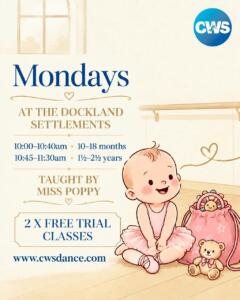
Baby & Me Ballet, 10 to 18 months. Mondays at 10:00 to 10:40am, Dockland Settlements.
Baby & Me Ballet, 1.5 to 2.5 years. Mondays at 10:45 to 11:30am, Dockland Settlements.
Pre-school ballet, 2.5 to 3.5 years. Parent-and-child classes developing early ballet foundations.
Pre-school ballet, 3.5 to 4.5 years. A nurturing drop-off class supporting independence and school readiness.
You can read more about our pre-school ballet classes or find out more about Baby & Me Ballet.
A gentle beginning
Baby ballet is not about rushing your child towards formal technique. It is about giving them time to notice, listen, move, imagine and connect.
The foundations are small but meaningful, a shared song, a first clap on the beat, a confident step away from your knee, a remembered action or a moment of joyful eye contact.
If you would like to explore this beginning with your child, you are warmly invited to book a trial class. If you have questions about age groups, settling in or what to bring, please get in touch with CWS Dance. We are always happy to support you.